
The Center for Liberal Arts Work (CLAW) at Anne Arundel Community College brings students, teachers and the community together to to discuss important ideas and transformative texts. It focuses on conversations around big, thought-provoking questions and helps connect general education classes in a clear and meaningful way.
CLAW is supported by a Teagle Foundation's Cornerstone: Learning for Living Initiative Grant.
As part of CLAW, every two years we ask a new Big Question that our program circles around. The Big Question sparks conversation and inquiry, frames CLAW classes and asks us to think across a variety of subjects in search of answers. It's a starting point that looks at how different fields of study approach problems, how their models intersect and what answers we can find in and out of the classroom.
Our current Big Question is, "What is an individual’s responsibility within a community?"
The Big Question will rotate every two years, which means you can work on more than one in your time at AACC.
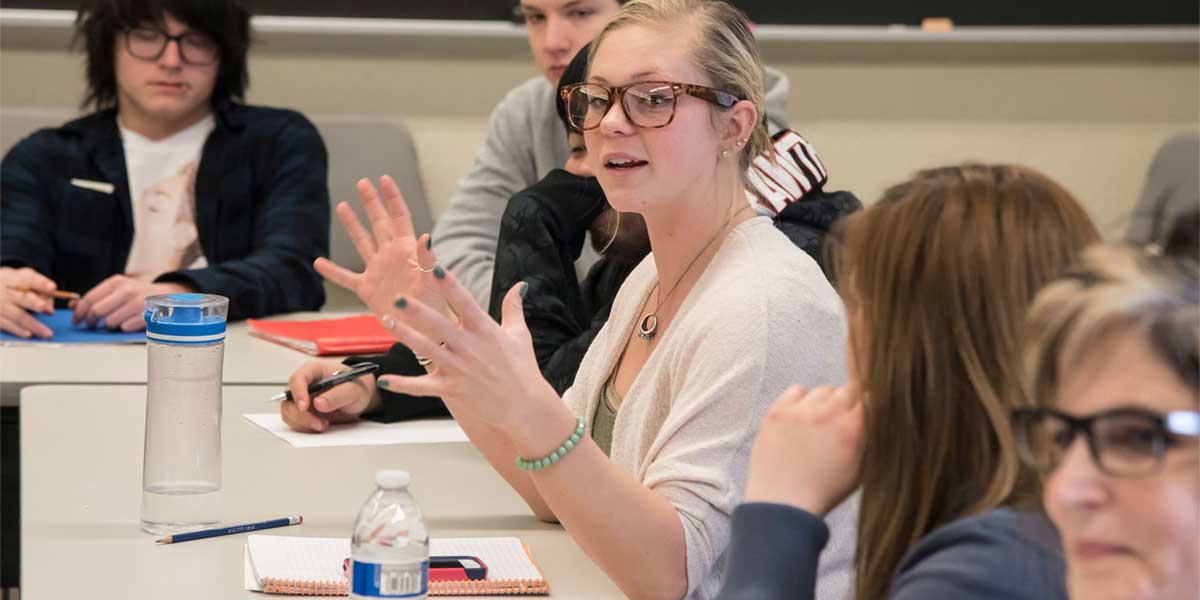
A seminar is a class founded on student-driven conversations. The professor is there each step of the way to guide and contribute to discussions. As a student, this means that you’ll turn up prepared to discuss what you’ve read and experienced with your peers and professors and that they, in turn, will be prepared to listen and to respond actively to what you’ve said. A seminar isn’t a way to quiz you; it’s a way for all of us to participate in knowledge sharing and knowledge creation.
Are you a student? Great! You’re admitted!
When registering for classes, search for “seminar” as an instructional method. Register. You’re in!
Need help registering? Check out our videos or how-to guides!
All CLAW courses help you fulfill general education requirements for your associate degree. You will explore your values through seminar classes and events that address the Big Question and you'll learn how to express those values, principles and ideas in written assignments and in student-driven discussions. The strong communication skills you build in CLAW courses are an added benefit to the knowledge you gain in the general education portion of your degree program.
The following courses are available as seminars:
You can earn a letter of recognition in Applied Humanities while you complete your general education requirements. This additional credential stacks into any associate degree program, meaning your credits count toward the letter of recognition and your associate degree at the same time. When you apply for transfer to a four-year college or university, the admissions committee will be able to consider your letter of recognition in Applied Humanities and the letters of recommendation you can ask your CLAW professors to write for you. These additional documents will display your ability to hold your own in an academic discussion and can influence your four-year university’s offer of admission and scholarships.
In this capstone course, we explore the Big Question, which changes every two years, by looking at it from different perspectives. Through class discussions, we work on building well-rounded answers. We also learn how to do active and ethical research and create hypotheses in the humanities. The course ends with a capstone project and a portfolio that shows how your thinking has grown throughout your general education seminar classes.
The portfolio includes work that you have completed throughout your CLAW seminars. During your capstone course, you will work on revisiting and revising that work and you will create, compose and/or consider new approaches to a research-based inquiry related to the Big Question.